Monday, May 16, 2011

World Championship!!


So--it was World Championship hockey time in Slovakia for the past several weeks.  Countries' teams from around the world (o.k., Europe and North America) started out in Kosice in East Central Slovakia or here in Bratislava for the qualifying rounds, and then moved to Bratislava for the quarter- and semifinals and the finals.  If you follow hockey at all and can get past the Stanley Cup hype, you know that Finland won an all-Scandinavian final.

Unlike as in North American hockey, these guys come to play and not fight.  In fact, during the matches on TV there was some rough stuff but only one person got a double minor penalty (two consecutive 2-minute penalties).  By-and-large the games are competitive but not fistfights.  The same can be said for the fans.  They were happy, excited, sometimes rowdy, but never combative, at least that we saw.  It got crowded downtown and fans wore their team jerseys and consumed prodigious amounts of food and alcoholic beverages.


Mostly what the police had to do, from our point of view, was stand around and watch.  Yeah, there were incidents (the Danish team had all of their computers and things stolen from their hotel, for example), but mostly, everyone was very cheerful.

The city was duded up, of course.  Folks couldn't remove all of the graffiti or tear down all of the derelict buildings, but the city looked good.  Players "posed"
for fiberglass statues around town, many times placed around the appropriate embassy.  The French team, with a statue in front of the French embassy, alas did not make it out of Kosice, but the young USA team (with the USA statue in front of the Embassy of the United States) did--for one game.  They lost to the Czechs 4-0 in the quarters. What team does the tie-dye guy represent?  We're really not sure.  But. as you can see from the pictures, the statues attracted attention! Even the performance art people got into the action, like the goalie.

Gooool!!!
?????
 The city managed to put an erector set something in the middle of the main square that we couldn't figure out.  It didn't even move, at least that we saw.  They put the Slovak, Canadian, American, and French flags on the main pillars.  None of those teams made it out of the quarterfinals.
 Even the guy in the top hat and tails in front of the fauncy Cafe Palffy managed to have a Team Slovakia scarf and a hockey stick. 
But, as you can see, the bottom line (yes, the lady has her hand on the statue's but, by it's bottom line) is that now a few more people know that Slovakia is not Slovenia.  Slovakia beat Slovenia and the Danes, but lost to the big teams and didn't make the second round.  The Slovenes lost to everybody, but their fans, at least the ones we saw, were rowdy and good-hearted.  Although we didn't get to a match in person, we got to engage in what we like best--people watching!

Saturday, April 9, 2011

To Market, to market...

No, we didn't buy a fat pig, but we bet you could--at least in parts.  

Paula goes most Saturdays we're in town, when it isn't too cold. Miletićova is the biggest market, about a twenty minute tram or bus ride, depending on which end of the market you want to start on.  Paula invited the photographer along this morning.   
We started out with the Peruvians (?) selling CDs and playing fine (if not typically Slovak) music. 

There are some folks along the way to the market selling notions and flowers and plants, but generally you head down the street for the main stalls.

The main commodity we head for is food, and there are many sellers with quite a variety of veggies, fruit, meats, bread, stuff that's pickled and stuff that's not, cooked 

and raw, loksé (see Christmas, above)--in short, about all you want.  Many stalls sell clothes, mostly made in Southeast Asia and run by Southeast Asians.  We suppose, or at least we like to think, that the food stalls are run by the people who grow the food.  Well, some foods are available before they could be ready in Slovakia, and after the first frost has taken any of the summer veggies away.  Some of the 
strawberries and many of the early and late arrivals come from southern climes like Spain, Israel, Turkey, and Northern Africa.  Whatever, they're fresher and in greater variety than the super markets.

Onions and eggplant, and peppers, oh my! And tomatoes came home with us, as did some white asparagus.  'Tis the season, after all. 


And, speaking of the season, vendors have a lot of bedding plants out; flowers and all kinds of vegetables.  Paula has a window garden going now, and if it flourishes, I'm sure it will be the subject of a future post.


We're also glad for the fresh cut flowers.  Today some tulips and freesia came home with us to brighten up the living room.  The sun shines prettily through the honey as well, but


there's a guy that sells honey in the pedestrian tunnel by our bus stop, so that's where ours comes from.  At least those are a few things that don't come from TESCO!

Sunday, March 20, 2011

Around the City, Ples, and Guests

Is it March already?  Actually, it's more than halfway through the month.  Tomorrow, Spring begins!  We thought, with visits from friends and family impending, we ought to get to know the city we live in a little better.  We've always found that the best motivation for getting out and about is the obligation to show people around!  This view is taken from Slavin, the monument to Soviet soldiers who died in the liberation of Slovakia from the Germans in World War II.  If the haze would part, you could see our flat.  At least, we can see the monument from our windows!


In Central Europe, at least in Slovakia, people and organizations sponsor formal balls instead of Mardi Gras parties as Lent approaches.  The ples sponsored by the Evanjelicke Lyceum took place on March 5.  In former years, American teachers have been asked to perform something; fortunately for us, this year the planners went for an all-student program, including everything from a string quartet to reggae dancers.  Great!  We did have to dress up, though.  The table decorations were lovely, the company was exhilarating, and (best of all) with one notable exception (the Blue Danube), other people did the dancing!

Schonbrunn, from the Glorieta
Two days later we went to Vienna to meet Dick and Sylvia. Although the weather was cool, we went to the Schonbrunn Palace, eating lunch along the way at a place with live jazz with a distinctly zydeco flavor (typical Austrian, right?).  We toured the palace where Maria Theresa ruled (she was crowned, or "coronated" as they say in Europe), in Bratislava, which was then Pressburg, but more about that later), and one of her sixteen children, Marie Antoinette (Louis XVI, revolution, let them eat cake, and all of that) grew up. Then we went up the hill to the Glorieta, a little cafe with great views, to take pictures and have a little something.

They went off to Poland, and we went home.  They came to Bratislava the Thursday after, and got a flavor of how we live, complete with staying in the flat, going to choir practice that night and going to school the next morning where they visited classes and toured the library.  We ate, went around the city some, and then took in a philharmonic concert complete with a pre-concert potluck.  The next day we went by train to Trencin, and got to tour the castle as well as the town.  On Sunday after church, we ate (again) and toured the city some more, including the Bratislava Castle.  Bratislava, then Posony or Pressburg, depending on whether you came from Hungary or Austria, became the capital of the Austro-Hungarian empire when the Turks conquered Budapest in the middle of the sixteenth century, and remained the capital until nearly the end of the eighteenth century, even though Budapest was taken back from the Turks a hundred years earlier.  I guess it was a shorter ride from Vienna, where the rulers really wanted to be.  The castle appears in the distance in this post's very first picture, and we had our group picture taken there, too, thanks to a handy gorillapod and trash bin!

Back at school, Paula's having students give a glimpse of Slovakia for her "Slovakia, My Homeland" unit.  While they can be very cynical about the country, they can also be very proud of what's here--enough that the presentations are very good and lasting twice as long as Paula predicted!  One student wore her grandmother's traditional costume for her presentation, and then brought it back the next day for Paula to put on!

So, who knows what next.  Spring is sprung, we're getting lots of good ideas about what to see, we're involved with things here....  Such problems!  More to follow.... 

Monday, March 7, 2011

Beautiful, and Cold, Budapest

We should have known, I guess, that it would be cold in Budapest at the end of February, but that's when our "Spring" break was, so that's when we went.  We stayed in Buda, in the Burg Hotel which is (not surprisingly) in the castle, since that's what "burg" means in German.  The hotel stands right across the square from St. Matthew's Church.  Paula saw a view of the church on line with scaffolding and shrouds, but no such screen existed when we arrived.  Workmen had taken everything down two weeks before.  Three bells sat on the ground, but a crane lifted them up into the belfry tower on Monday.  We could have stayed around to watch the process, but too many places called to us.  We went for a walk and saw St. Mary Magdalene church, or what's left of it.  The Hungarians worshiped there when the higher caste "Germans" (Austrians) used St. Matthew's.  Heavily damaged by wars, the only pieces left of St. Mary
St. Mary Magdalene
Magdalene are the tower and one reconstructed arched window to show where the altar stood.


St. Matthew's
Sunday morning we attended high mass at St. Matthew's.  Apparently a high mass is sung at 10AM each Sunday.  This was Mozart's Mass in C Minor, with a fine orchestra and choir. In the afternoon we took the tour of the Parliament building.   We tried to walk around and look at architecture, but looking at buildings is more difficult when you shiver.


We went to the market on Monday morning, bright and early. Shopkeepers, bundled up against the cold, opened food stands on the ground floor, but many of the tourist shops opened more slowly.  The eateries opened by 10AM and we did have coffee. 
Having coffee in the market
After lunch we 
Parliament, in Pest, as seen from Buda.
went to the Grand Synagogue and took the tour there.  Parliament, of course, had heat, but even though the synagogue (as with most if not all places of worship in Central Europe) had no heat, being inside and out of the wind warmed us up.   


Tuesday we bathed.  Budapest is known for its thermal baths.  The Hungarians built two, one in Buda and one in Pest, in the late Nineteenth Century.  We went to Szechnanyi, in Pest.  It has two outside pools, one at body temperature and one about twenty degrees cooler.  Once we got in we were fine, but being in a "hot tub" with snowflakes falling on your head is a little strange.  Tuesday afternoon we found the "shoes"
Shoes
on the bank of the Danube.  We heard about the shoes during the synagogue tour, but could not find them later Monday.  The exhibit, sixty sets of period-appropriate shoes, commemorates Jews who hid from the Nazis during World War II but were taken from hiding by a group of Hungarian sympathizers in early 1945, marched to the Danube, and shot into the water.  A sculptor placed the bronze shoes in the early 1990s.

We also enjoyed the National Gallery and the "Labyrinth."  Wednesday we went back to the market briefly and then caught a train for home.  It had been cold in Bratislava when we were gone, and our friends who went to Ljubljana, Slovenia, and Kiev reported very cold temperatures, too.

Saturday, February 5, 2011

Hokej!

 The title of this post is a Slovak word--the "j" sounds like a "y"--and we bet you'll be able to pronounce it, and even know what it means!


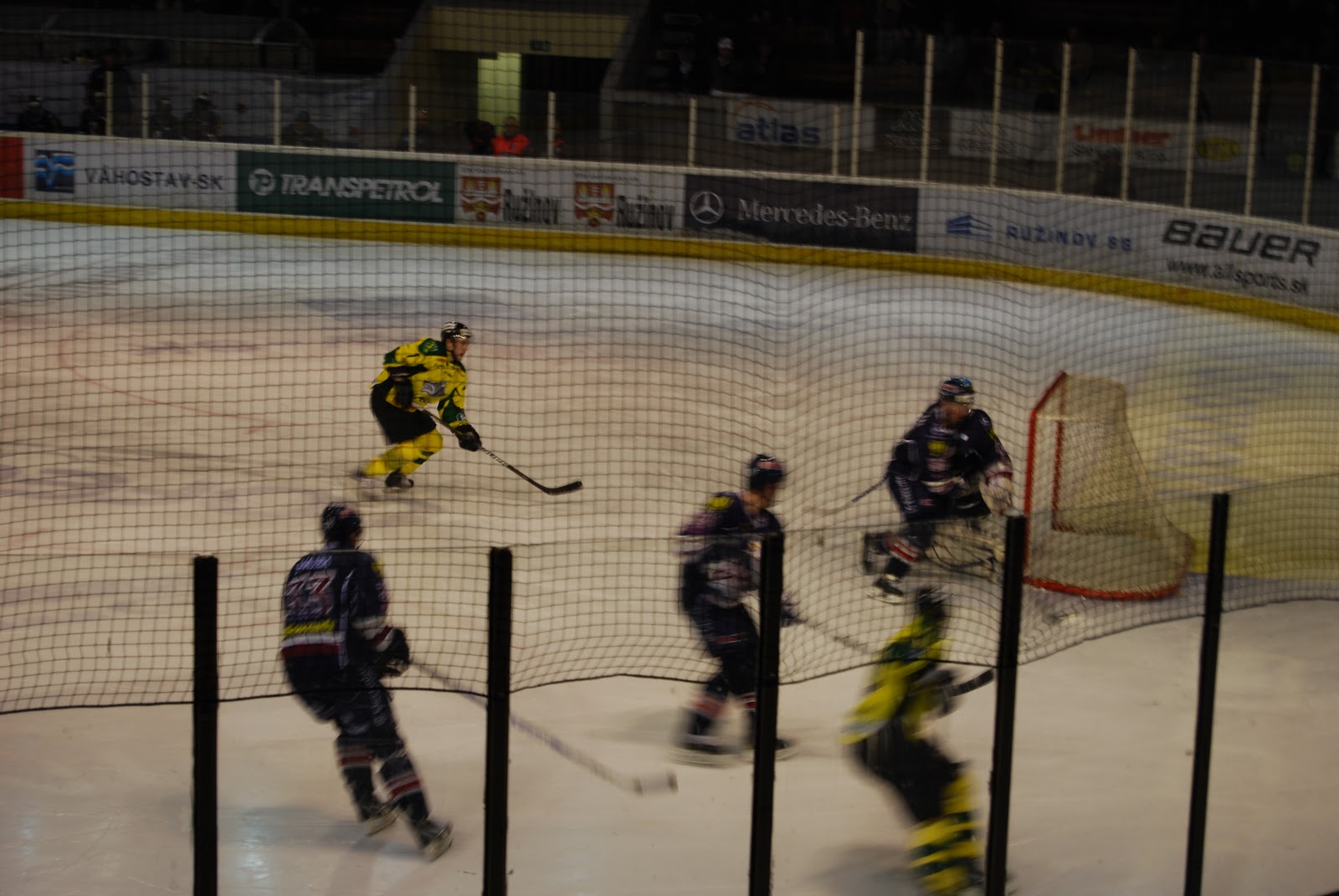
Yes, we went to a hockey match.  Hockey is Slovakia's national sport, like football or baseball to the United States.  We went on the tram, a group of us from the International Church and the school--which is ninety percent the same crowd.  That shouldn't surprise anyone, since the intern pastor and her intended organized the trek, and he played for the U  of North Dakota team (he's at Luther Seminary now, studying from the seminary here).  Slovakia sends a number of players to the National Hockey League; in fact, has quite a few in the league now.  Several players in the Slovak League have NHL ice time.  Bratislavans like skating so much that the Main Square has been turned into an ice skating rink.


European hockey is fast and clean; not a lot of fighting, since fights result in an automatic major (5 minute) penalty.  This night, the Bratislava team (Slovan)  hosted Zilina.  In the eleven-team Slovak league, Slovan is fourth and Zilina tenth.  Alas, Slovan played down to Zilina's level, but managed to win, 2-0.

Yes, there is a Zamboni, although the driver looked nothing like Snoopy.  The match took place in the old Samsung stadium, which will go the way of all old stadia soon.  Slovakia will host the World Championships in April and early May, and Bratislava is building a brand-new stadium.  They appear to have a long way to go before it is done.  Slovan hopes to make the Slovak League playoffs, and hopes to use the new stadium.  The fans probably hope so, too.

After the match, the teams shake hands and Slovan lines up, kneels, and (we think) pays its respects to the fans.  This is as it should be, since the fans pay the bills.  After the match, we went out to catch the tram, and it was, appropriately enough, snowing.


No, we don't have tickets to any of the World Championship games.  The US team starts out the tournament in Kosice, which is in Eastern Slovakia, and only comes to Bratislava if it makes it to the quarterfinals.  We're not rich enough, or big enough hockey fans, to pay 70+ euros a ticket, and we're probably not big enough fans to go to a match between, say, Slovenia and Russia.  We were glad, however, to pay 1/35th of that price for tickets to see Slovan play!

Sunday, January 16, 2011

In the Bleak Midwinter...

Goodness--it's been a month--no, five weeks--since the last post. Sorry! A lot has gone on since December 11, so forgive us. We were in the U.S. from December 20 to January 5, and we took Europe's snow with us, first to Virginia and North Carolina, where we woke up to five inches on the Outer Banks on December 26. More than 14 inches fell on Virginia Beach, so needless to say we did not get to St. Paul's, Hampton for that Sunday's service. Enough was plowed that we got off to Denver on December 28, where we brought eight inches of the white stuff. They are better equipped than the Mid-Atlantic for handling a snowfall, so we got around just fine. We had no problems returning and getting back into the school swing of things. The Lyceum came to life again on January 10, and the first semester ends this week.

Meanwhile, we thought you might like to see a bit of the International Church of Bratislava, where we hang out. The International Church is a ministry of the Evangelical Lutheran Church in
America, but draws English speakers from many countries--the U.S., Great Britain, Canada, several African countries, the Scandinavian countries, Germany, Austria, Germany, Poland, Hungary, France, Ireland, Mexico and (of course) Slovakia are the ones that come to mind now.

A quick history--the Evangelical church in Austria-Hungary took off quickly after the Protestant Reformation in the Sixteenth Century, and nearly eighty percent of all residents in what is now Slovakia became Protestant. The Counter Reformation at the end of the century and the beginning of the Seventeenth Century forced recantation or pushed the Protestants out of cities and towns. In Pressburg, now Bratislava, Evangelicals could only meet outside the city walls, or palisades, so now the oldest part of the church is in residence beyond a street called Palisady, which runs along where the walls once stood. It took until the end of the Eighteenth Century for any tolerance to creep back into Austria-Hungary; Maria Theresa and her son Joseph signed the Declaration of Tolerance in 1781 which allowed the building of Protestant churches so long as they were erected without nails and with no steeples. In Bratislava, the Evangelical church built the Velky Kostol and the Maly Kostol, the big and little churches, of
rock. The International Church now meets in the Maly Kostol at 9:30 A.M. between the services of the German speakers at eight and the Hungarians at eleven. The church bears witness to its past; inscriptions inside and out thank Maria Theresa and Joseph for their willingness to let the Evangelicals build a place to worship.

You can find the building by the map at the website (http://www.bratislavainternationalchurch.org/Home), or by listening for organ music, or by asking. The door to the courtyard is usually open, leading to a foyer and thence to the nave. The organ dates, the organist figures, from the early Nineteenth Century. Even though the appointments such as the altar and pulpit, seem to be marble, they are actually made of wood. The church's official website has better pictures of the interior than we have, with a few exceptions posted here, and we commend it to you even though Arden and Anna have not posted their sermons! After the service we walk past the Big Church down to the Backpacker's Hostel for fellowship. For choir practice and other events, you must go in the back of the church through the Next Apache Coffee House/Bar/Used English Bookstore run by a Canadian; the name comes from how our ears, tuned to English, hear "nech sa paci," which the Slovaks use for anything from "next in line" to "after you" to "at your pleasure" to "come in" to "may I help you?" Paula's Slovak students, of course, say that the two phrases sound nothing alike. Hmmm.... Well, we'll try to do better next time at getting posted.